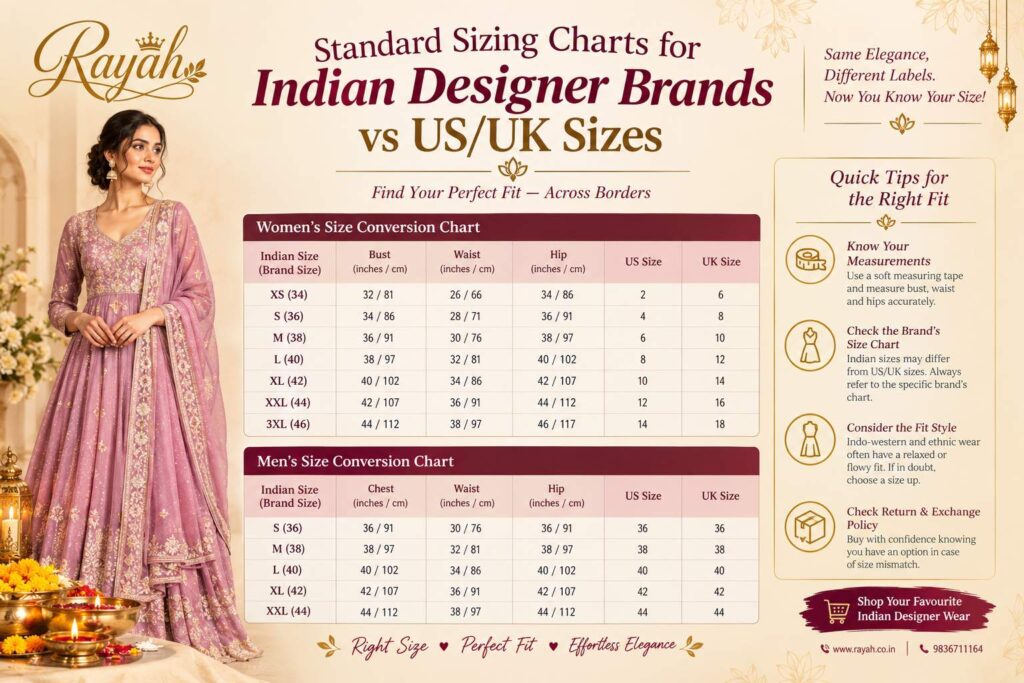
Standard Sizing Charts for Indian Designer Brands vs US/UK Sizes
- October 5, 2026
- admin
- 3:49 pm
Buying Indian designer wear online can be exciting until you reach the size selection. A US 8, UK 12, Indian 40 and an “M” can all refer to different measurements depending on the garment and designer.
The safest approach is simple: do not convert a size label alone. Compare your actual body measurements with the designer’s chart before ordering.
This is especially important for fitted blouses, lehengas, kurtas and occasionwear, where a difference of even one or two inches can change the way an outfit sits.
Quick Answer: Are Indian, US and UK Sizes the Same?
No. Indian clothing sizes do not follow one universal conversion system across every designer.
As a general reference, women’s Indian ethnic wear often uses measurements such as 32, 34, 36, 38, 40 and 42, while international clothing may use XS–XXL or numerical US and UK sizes.
A general comparison looks like this:
| Indian Size | Approx. Bust | General Letter Size | Approx. US | Approx. UK |
|---|---|---|---|---|
| 32 | 30–31 in | XS | 0–2 | 4–6 |
| 34 | 32–33 in | S | 4–6 | 8–10 |
| 36 | 34–35 in | M | 6–8 | 10–12 |
| 38 | 36–37 in | L | 8–10 | 12–14 |
| 40 | 38–39 in | XL | 10–12 | 14–16 |
| 42 | 40–41 in | XXL | 12–14 | 16–18 |
| 44 | 42–43 in | 3XL | 14–16 | 18–20 |
These figures are reference ranges, not fixed rules. Individual designers can grade their garments differently.
That is why a conversion chart should be your starting point, not the final decision.
Why Indian Designer Sizing Can Be Different
One of the biggest mistakes shoppers make is assuming that an Indian “M” will fit like an American or British “M”.
Designer ethnic clothing is often designed around the construction of the particular outfit.
For example, a relaxed kurta may allow more room through the waist, while a fitted blouse needs a much closer measurement around the bust. A lehenga may have an adjustable waistband, while a structured jacket may depend heavily on shoulder and chest measurements.
There is also something called garment ease.
Garment ease is the extra room between your body measurement and the finished garment measurement.
For example, if your bust measures 36 inches, a relaxed kurta might be designed with several extra inches around the bust. A fitted blouse may have considerably less room.
This means two garments carrying the same size label can feel completely different.
Indian Designer Size vs US/UK Size: What Should You Measure?
Before ordering, take four basic measurements:
- Bust or chest – Measure around the fullest part without pulling the tape tight.
- Waist – Measure around your natural waist.
- Hip – Measure around the fullest part of your hips.
- Shoulder – Measure from one shoulder point to the other.
For lehengas and long dresses, also check garment length.
For blouses, sleeves and fitted tops, bust and shoulder measurements deserve extra attention.
Use a soft measuring tape and measure over light clothing. If possible, have another person help you so the tape remains level.
The Most Useful Rule: Measure the Largest Area
What happens if your bust says 36, your waist says 38 and your hips say 40?
Do not automatically choose a 36 because it is your usual label.
For many structured outfits, it is safer to select the size that accommodates the largest relevant measurement and then consider alteration.
This is particularly useful with lehenga skirts, fitted blouses and tailored ethnic sets.
An outfit that is slightly loose can often be adjusted. An outfit that is too tight may have limited alteration options, especially where embroidery, lining or structured panels are involved.
A Better Way to Read an Indian Size Chart
Instead of asking, “What is my size?”, ask three questions:
| Question | Why it matters |
|---|---|
| What are my body measurements? | Gives you a reliable starting point |
| What are the garment measurements? | Shows how the actual outfit is cut |
| Where is the outfit fitted? | Identifies the measurement that matters most |
For example, if you are buying a loose kurta, bust and shoulder may be your main checks.
For a blouse, bust, underbust and shoulder can become much more important.
For a lehenga, waist and hip measurements usually deserve priority.
For a jacket or structured ethnic outfit, chest and shoulder fit can determine whether the garment looks polished.
What About US and UK Sizes?
US and UK women’s sizes are not interchangeable.
For example, a US 8 is generally not the same numbered size as a UK 8. This is why shoppers moving between countries should avoid simply carrying the number across.
The Indian equivalent also depends on whether the designer is referring to a body measurement, garment measurement or a letter size.
If you normally shop in the US or UK, keep your measurements in inches or centimetres and use the designer’s chart to find the closest match.
That approach is much more reliable than memorising conversions.
A Useful Trick for Buying Indian Ethnic Wear Online
Before ordering an expensive occasion outfit, take a garment you already own that fits you well.
Lay it flat and measure key areas such as:
- Bust
- Waist
- Hip
- Shoulder
- Sleeve
- Overall length
Then compare those measurements with the product information available for the new outfit.
This gives you a real-world reference instead of relying only on a letter such as S, M or L.
It is especially helpful when shopping for wedding outfits, festive clothing and other pieces where returning or altering the garment may be inconvenient.
Choosing Your Size at Rayah
When exploring designer Indian ethnic wear online, use the same measurement-first approach.
Rayah’s Indian ethnic wear collection includes designer pieces created for weddings, festive celebrations, parties and special occasions. The collection features lehengas, contemporary kurta sets and sarees with modern silhouettes and detailed finishing.
Because these are occasion-focused garments, the way the outfit is intended to fit matters just as much as the size label.
If you are between two sizes or unsure about the fit of a particular Rayah design, check the product information and contact Rayah before ordering to confirm the appropriate sizing for that piece.
Explore Rayah’s Indian Ethnic Wear Collection
Indian Size Conversion: The Rule to Remember
There is no single conversion table that can guarantee the perfect fit.
A general US-to-Indian or UK-to-Indian conversion can help you narrow down your options, but your body measurements should always be the final reference.
Think of the process this way:
Country size → Indian equivalent → body measurements → garment type → final size
That last step is what many generic size guides miss.
A size that works for a relaxed kurta may not be the right choice for a fitted blouse. Similarly, a lehenga waistband may offer adjustment that a structured top does not.
Indian designer sizing is easier once you stop treating size labels as universal.
Use US or UK sizes only as a starting point. Measure yourself, check the relevant part of the garment, consider how much ease you need and then compare those figures with the designer’s information.
For special-occasion clothing, this small extra step can make a major difference to comfort and appearance.
Whether you are shopping for a wedding, festive celebration or an elegant evening event, choosing by measurements rather than labels gives you a much better chance of getting the fit right the first time.
Is Indian sizing the same as US sizing?
No. Indian, US and UK clothing labels use different sizing conventions. Indian ethnic wear may also use numeric measurements or letter sizes depending on the designer.
Is an Indian 40 the same as a US 10?
Not necessarily. An Indian 40 may broadly correspond to a similar body range as a US size 10–12, but the actual fit depends on the designer and garment.
Should I choose my normal size when buying ethnic wear online?
Not automatically. Compare your bust, waist, hip and shoulder measurements with the product's size information before ordering.
What measurement is most important for a lehenga?
Waist and hip measurements are usually the most important for the skirt, while bust and shoulder measurements matter for the blouse.
What if I am between two sizes?
For fitted garments, choosing the larger size and having it altered can often be safer than choosing a smaller size that is too tight. However, always consider the construction of the particular outfit.
Why does the same size fit differently on two Indian outfits?
The difference usually comes from the garment's cut, fabric, silhouette and ease. A relaxed kurta and a fitted blouse can have very different finished measurements despite carrying the same size label.
Can I use a US or UK size chart to buy Indian designer wear?
You can use it for an approximate conversion, but it should not replace the Indian designer's own measurements. Your body measurements are a more dependable reference.
Product categories
- Casual Wears (5)
- Indian Ethnic Wears (9)
- Indo Western Ethnic Wears (23)